
ACL Reconstruction -vs- BEAR Implant: Expert Surgeon Opinion
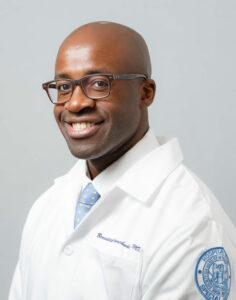
If you’re deciding between ACL reconstruction and the BEAR implant, Dr. Benedict Nwachukwu can help you understand your options and determine which approach may be best for your injury, goals, and return to activity. Dr. Nwachukwu provides diagnosis and and the best treatment options for patients in Manhattan, New York City, NY who have a torn ACL. Contact Dr. Nwachukwu’s team today!
Why Dr. Benedict Nwachukwu Recommends Proven ACL Reconstruction for Most Active Patients
Need to Know:
The BEAR Implant is an exciting new option for certain ACL tears, however, it is not always the best choice for everyone. While early research is encouraging for the BEAR Implant, traditional ACL reconstruction remains the gold standard for most active patients. The reason ACL reconstruction is a better choice is because it is backed by decades of proven results, reliable knee stability, and a well-established path back to sports.
What is the best way to fix a torn ACL?
Every year, thousands of athletes and active adults tear their anterior cruciate ligament (ACL). In fact, it is the most common injury in sports. One of the first questions many patients ask is, “What’s the best way to fix it?”
Recently, the BEAR Implant (Bridge-Enhanced ACL Restoration) has received significant attention as an alternative to traditional ACL reconstruction. The concept is appealing, allowing the ACL to heal itself with a little help from technology and an implant…but it is important to understand how it compares to the procedure that has successfully restored knee stability for decades.
For Dr. Benedict Nwachukwu, a fellowship-trained orthopedic sports medicine surgeon at Hospital for Special Surgery (HSS), the goal isn’t to recommend the newest procedure, it is to recommend the treatment that offers the best chance for long-term success based on each patient’s specific injury, goals, health, and activity level.
What happens when you tear your ACL?
The ACL is one of the primary ligaments that stabilizes the knee. It prevents excessive forward movement of the tibia (shinbone) and helps control rotational movements of the knee during activities like cutting, pivoting, landing, and sudden changes in direction.
ACL injuries are seen most commonly in these sports:
- Basketball
- Soccer
- Football
- Skiing
- Tennis
- Pickleball
- Running and fitness activities
- CrossFit
Most of our patients report hearing or feeling a “pop” in the knee, followed by swelling, pain, and a feeling that the knee wants to “give out.” Without a stable ACL, returning to cutting and pivoting sports is often difficult, if not impossible. Ignoring the problem, or not receiving the best treatment, may cause of additional injuries to the meniscus or cartilage.
Why can’t a torn ACL heal on its own?
Unlike many ligaments elsewhere in the body, the ACL has very little ability to heal naturally. The ligament sits inside the knee joint, where it is surrounded by synovial fluid. While this fluid helps lubricate the knee joint, it also prevents the blood clot formation that is necessary for healing after an ACL tear. As a result, most complete ACL tears do not reconnect or heal on their own.
What Is the BEAR Implant?
The BEAR Implant was developed as a way to preserve the patient’s own ACL instead of replacing it with a tendon graft. During this type of surgery, a collagen implant made from bovine tissue is placed between the torn ends of the ACL. The implant is designed to create an environment that encourages the ligament to heal by supporting blood clot formation and tissue repair.
The concept is innovative, and early clinical studies have shown encouraging short-term results in carefully selected patients. However, because the procedure is relatively new, there is still limited information about its long-term durability, particularly in young athletes and highly active individuals.
Why traditional ACL reconstruction remains the gold standard of care:
Innovation is an important part of orthopedic surgery. But new doesn’t always mean better. Traditional ACL reconstruction has been performed successfully for decades and remains the most reliable treatment for most patients who want to return to sport or to high-demand activities. ACL reconstruction does not repair the torn ligament, but instead, replaces it with healthy tissue. This can be from an autograft (the patient’s own tendon) or an allograft (donor tissue).
Using a graft to reconstruct the ACL has has consistently demonstrated excellent knee stability, predictable outcomes, and high rates of return to activity. For many athletes, the proven result is the strongest reason to choose traditional reconstruction.
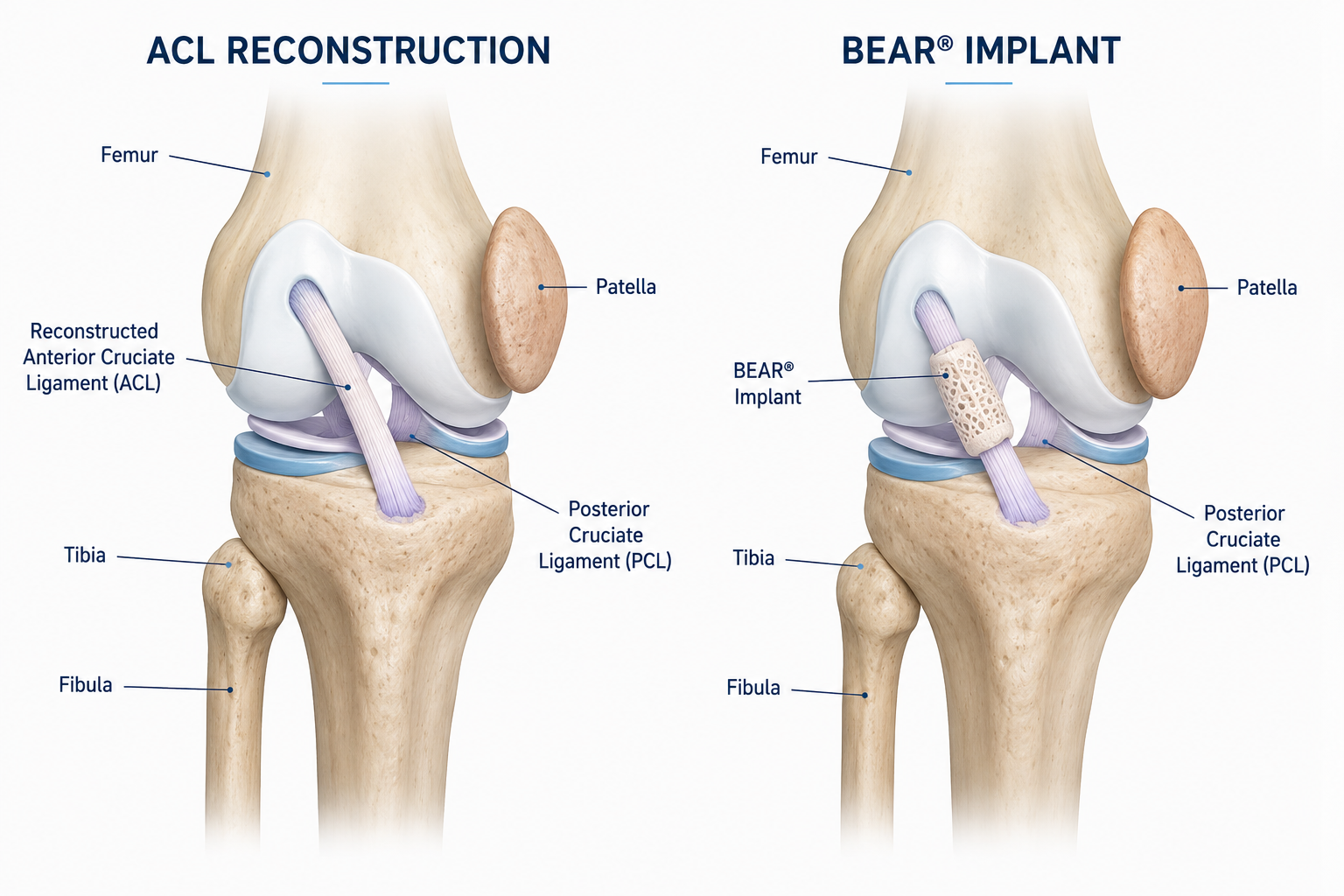
*AI-generated medical illustrations are for informational purposes only and may not be anatomically precise.
| BEAR Implant vs. Traditional ACL Reconstruction | |
|---|---|
| Traditional ACL Reconstruction | BEAR Implant |
| Backed by decades of research | Limited long-term data |
| Proven durability | Long-term durability still being studied |
| Well-established return-to-sport outcomes | Early results are promising but still evolving |
| Lower revision rates in current studies | Slightly higher revision rates reported in early research |
Both procedures have shown encouraging short-term outcomes. But in our experience we have seen that traditional ACL reconstruction continues to provide the strongest long-term success for active patients and elite athletes.
What Does the Research Show regarding ACL Reconstruction and the BEAR Implant?
Early studies comparing the BEAR Implant with traditional ACL reconstruction have reported similar patient satisfaction and knee function after two years. One of the largest studies, the BEAR II Trial, found that patients treated with the BEAR Implant had comparable functional outcomes to patients who underwent hamstring autograft ACL reconstruction.
Researchers also reported improved hamstring strength in the BEAR group because no hamstring tendon was harvested during surgery.
However, the study also found that patients treated with the BEAR Implant experienced a higher revision surgery rate than those who underwent traditional ACL reconstruction.
These early findings are encouraging, but they also highlight an important point: Two years of data is very different from decades of proven outcomes. We believe that the long-term studies will ultimately determine where the BEAR Implant fits within modern ACL treatment
Who would be a good candidate for the BEAR Implant?
Although traditional ACL reconstruction remains the preferred option for many patients, the BEAR Implant may be appropriate in select situations. Potential candidates may include:
- Patients with specific ACL tear patterns
- Individuals who are less likely to return to high-impact sports
- Patients who wish to avoid tendon graft harvest
- Carefully selected patients treated soon after injury
Determining whether someone is a candidate requires a detailed evaluation by an experienced orthopedic sports medicine specialist like Dr. Nwachukwu.
Why Dr. Benedict Nwachukwu Recommends ACL Reconstruction for Most Active Patients
Every ACL injury is unique and not every tear is the same. Treatment decisions should be based on more than the latest technology or online headlines. They should consider the patient’s age, activity level, athletic goals, anatomy, and long-term knee health.
For most active individuals, Dr. Nwachukwu continues to recommend traditional ACL reconstruction because of its proven ability to restore knee stability, protect the joint, and support a safe return to sports.
As research continues to evolve, newer procedures like the BEAR Implant may play a larger role in ACL care. Today however, traditional reconstruction remains the most predictable and well-studied option for many athletes and active patients.
FAQ (Frequently Asked Questions)
Schedule a Consultation with an ACL and Sports Medicine Specialist New York:
Choosing the right treatment for an ACL tear is an important decision. Dr. Benedict Nwachukwu specializes in ACL reconstruction, complex knee ligament injuries, and sports medicine at Hospital for Special Surgery in Manhattan, New York City and surrounding New York boroughs. If you are considering the BEAR Implant or traditional ACL reconstruction, Dr. Nwachukwu can help you understand your options and he will recommend the treatment that best aligns with your injury, lifestyle, and long-term goals.
